In a disturbing case from the Lancashire area, a conspiracy to murder, a chilling plot that Lancashire Police themselves confirmed as a credible threat to life, has been swept under the carpet through an alleged act of perverting the course of justice by the Force Crime Registrar (FCR).
This refusal to record a serious crime, based on a blatant mis-categorisation, is in itself, a potential crime, and raises questions about accountability, transparency, and the integrity of crime recording practices in Lancashire police.
The FCR, who is tasked with ensuring accurate crime recording under the Home Office Counting Rules (HOCR), claimed that conspiracy to murder is a state-based offence, therefore, not requiring mandatory recording. This assertion, was relayed to the victim by Inspector Darcy in the following absurd email (click to expand it)
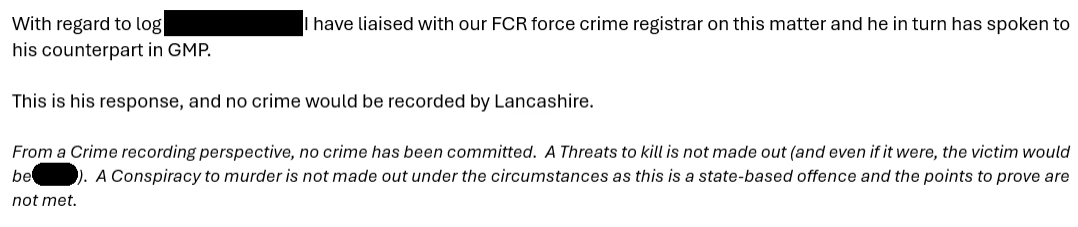
The advice from Lancashire constabulary’s expert on Crime Recording, who in-turn admits he spoke with his counterpart, (the FCR of Greater Manchester police). directly contradicts the HOCR which lists Conspiracy to Murder in a simple Look-Up table which correlates to a published list of Classification Codes, and Conspiracy to Murder, is a VICTIM based crime.
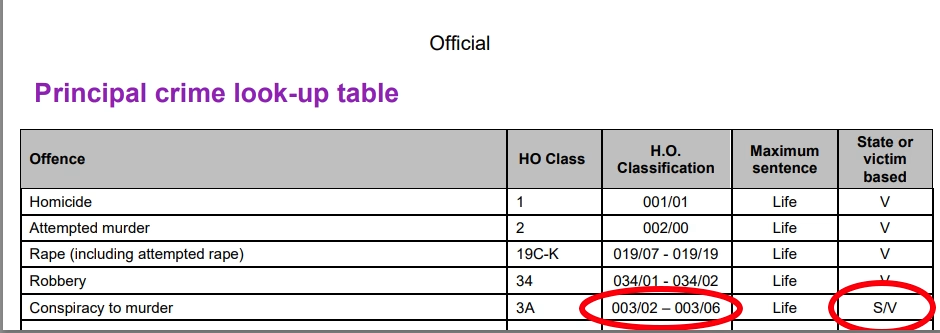
As you can see above, the tables clearly lists conspiracy to murder (H.O. Classification 003/02 – 003/06) as either Victim or Stated based.
That shows there are several classifications of this offence, and depending on the classification would determine if the offence is a victim or state based offence.
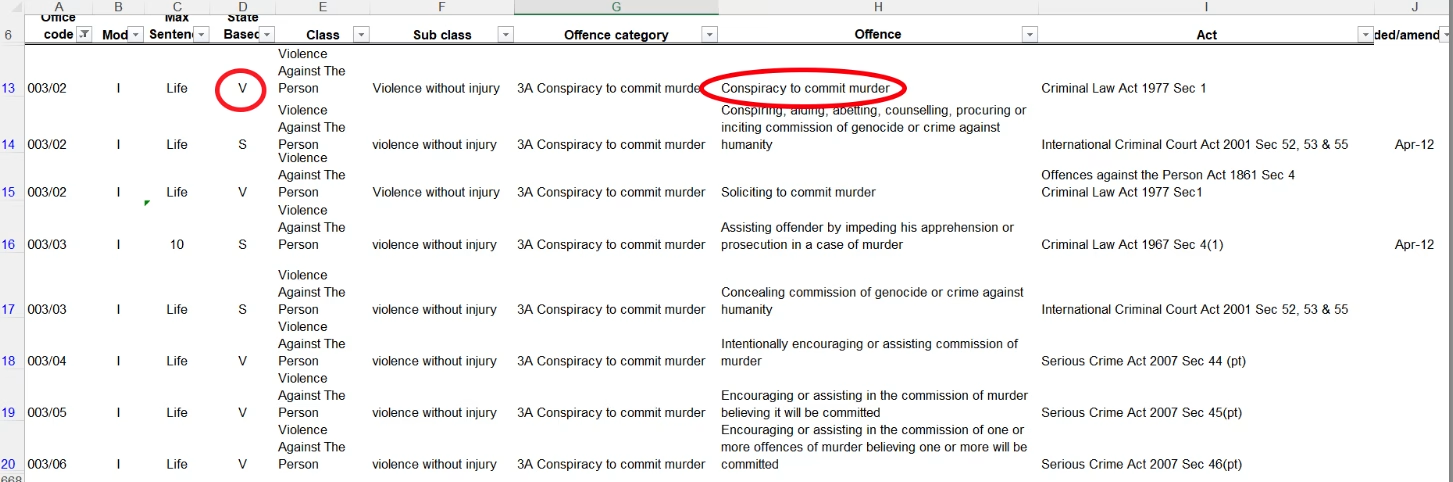
The spreadsheet below, published on the Home Office website, is where the offences are classified, and it is quite simple to see that Conspiracy to Murder is, undoubtedly, a victim-based crime.
How can the FCR get this so wrong?
What makes this case even more alarming is the FCR’s consultation with their counterpart at Greater Manchester Police (GMP). The Lancashire FCR, a senior officer with specialised expertise in crime recording (from the College of Policing), sought advice from (or conspired with) the GMP FCR before dismissing the crime, leaving the victim failed by the system, especially where the Victim Charter specifically says victim’s have a right
To have the details of the crime recorded without unjustified delay
It is implausible that two FCRs, both highly trained professionals responsible for upholding HOCR and the National Crime Recording Standard (NCRS) for an entire police force, could make such a catastrophic basic error.
The HOCR guidelines are unambiguous, and the FCRs’ roles demand a deep understanding of these classifications. This coordinated dismissal suggests a deliberate act to avoid recording the crime, alleged to protect suspects who are linked to a Lancashire Police prosecution. Such actions could constitute perverting the course of justice, a common law offence carrying a maximum penalty of life imprisonment, by obstructing the investigation of a serious crime (R v Murray [1982] 1 WLR 475).
The implications of this legally flawed categorisation are staggering. By refusing to record the conspiracy to murder, Lancashire Police have left a credible threat unaddressed, placing the victim at ongoing risk and denying them the protection they deserve.
This failure also distorts crime statistics, undermining the public’s ability to hold the police accountable for addressing serious offences.
The HOCR exists to ensure consistency and transparency in crime recording, yet the FCRs’ actions appear to intentionally disregard these principles, raising suspicions of a cover-up.
This has not gone unnoticed. The Chief Constable of Lancashire Police has been made aware of the situation, as has the Police and Crime Commissioner, who has a statutory duty to hold the force accountable under the Police Reform and Social Responsibility Act 2011.
The local MP has been informed, adding political pressure, and Lancashire Police’s Legal Services are aware of legal action, a judicial review to challenge the decision as being unlawful and illegal.
These authorities cannot ignore the gravity of the FCRs’ actions (although many will try), which strike at the heart of public confidence in the police.
The FCRs’ alleged misconduct is a betrayal of their duty to uphold the law and protect victims. The admission of a consultation with the GMP FCRs, far from being a mere procedural step, appears to be a calculated move to evade accountability or to infer authority.
If two specialists can so easily wrongly categorise a crime as serious as conspiracy to murder, what does this say about the integrity of crime recording across the region?
Until the FCR of Lancashire police is held to account, this case will remain a stark reminder of how those entrusted with justice can, through the abuse of power or their position, intentionally pervert the course of justice.
So far, the Lancashire FCR has refused to respond to the victim’s email, simply asking him to justify his flawed decision. He has failed to reply.
Be the first to comment