
On 8 October 2024, Tom Bates, the head of security at the Manchester Civil Justice Centre, threatened a member of the public in an incident amounting to a section 39 assault under the Criminal Justice Act 1988.
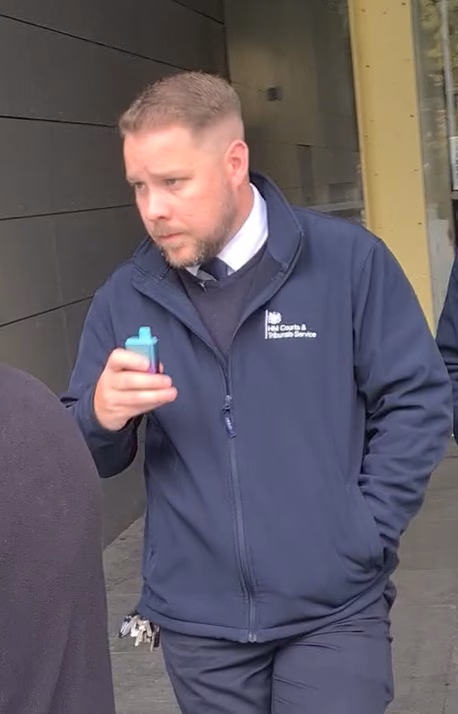
The confrontation occurred outside the court grounds, yet Bates, dressed in his HMCTS security uniform, demanded the individual hand over their mobile phone. When the individual firmly told Bates to “back off,” Bates escalated the situation, threatening the use of unlawful violence, “If you tell me to back off again, I will restrain you“.
In response, the individual issued a conditional warning, stating the force they would use only if Bates attempted physical contact Touch me and I’ll knock you out.
The response from Tom Bates was to attempt to start a physical altercation with the individual, recorded on CCTV removing his security attire to only then ‘step out of uniform‘, requiring his own security team he heads to restrain his violent outburst.
This incident, already troubling due to Bates’ misuse of authority, is further complicated by his contradictory conduct. On one hand, Bates projected authority by issuing threats while in uniform; on the other, he stood idly by as a female court user was assaulted by an angry woman outside the court.
The female assailant, after refusing to attend a voluntary interview with GMP and evading arrest, was charged via a postal requisition with section 39 assault. She is to appear in court on 14 May 2025 facing that charge. A complaint made with HMCTS about Tom Bates’ inaction during this assault was dismissed, with HMCTS claiming Bates had no authority outside the court building. This defence adds insult to injury, as Tom Bates now faces an assault investigation for his threats made off court grounds but while in his HMCTS uniform, highlighting a stark inconsistency in how his authority is applied.
These events, compounded by egregious police misconduct, raise serious questions about accountability and fairness in Greater Manchester Police.
The Incident and Its Aftermath
The member of the public, acting within their rights to refuse Tom Bates unwarranted demand, reported Bates’ threatening behaviour to the police, expecting an investigation. Instead, GMP arrested the victim, seemingly to talk to him over issuing a conditional warning to defend themselves against Tom Bates’ threat which itself was the underlying criminal act.
This arrest appears to have been a knee-jerk reaction, lacking legal grounding, as a conditional warning of self-defence does not constitute a criminal offence unless accompanied by an immediate threat of violence, which was not the case here.
The victim’s arrest highlights a disturbing trend of police overreach, where the complainant is punished rather than protected. Tom Bates, a supposed figure of authority at a Court Building (a security guard), should face disciplinary action, particularly given his role and the public setting. Yet, GMP’s focus, and HMCTS lack of action, suggests a bias towards protecting institutional figures over ordinary citizens.
Police Misconduct and PC Theresa Morgan’s Deceptions
The handling of this case by PC Theresa Morgan further erodes public trust in GMP. On 14 April 2025, waiting until after six months had passed from the incident, the victim sought an update on the investigation into himself and Tom Bates.
PC Theresa Morgan responded with an email stating,
An inspector has authorised the extension of your bail whilst we wait for a CPS charging decision. Your new bail date is 31/07/2025, and to report to Central Park Custody.
This claim was alarming (and a lie), as it implied the victim remained a suspect under active consideration for charges.
Suspecting foul play, the victim contacted the Crown Prosecution Service (CPS) directly, only to discover that no file had been submitted for a charging decision.
CPS responded to the enquiry:
If there is no URN [which there wasn’t] then the police have not sent the file of evidence to the CPS.
I’d therefore suggest that you refer this matter back to the police.
When confronted, PC Theresa Morgan quickly backtracked, claiming:,
Please disregard my email about bail, it was a miscommunication on my behalf with my Inspector… The email was premature and I apologise for this.
PC Morgan added
the investigation into Bates was still ongoing
and promised an update when a decision was made.
This so-called “miscommunication” is, at best, gross incompetence and, at worst, a deliberate attempt to mislead (misconduct in pubic office). Extending bail on a statute barred offence, and lying about CPS involvement is a serious procedural failing and one which only the dumbest officers could make such a mistake. It is suspected that it was an attempt to unjustly prolong the victim’s anxiety and uncertainty with an abuse of police powers.
Morgan’s admission that she assumed the inspector was “actioning” the bail extension reveals a cavalier approach to due process, where assumptions trump accountability. The victim, already distressed by the bias over Tom Bates’ threat and their wrongful arrest, faced additional harm from this false bail extension, which lingered unresolved for over six months.
Police Accountability in Question
GMP’s handling of this case is a stark example of police misconduct. The initial arrest of the victim for a lawful of a self-defence warning defies logic and fairness. PC Morgan’s false bail extension claim, only retracted after the victim’s diligence and knowledge of the law, is speculated as intentional deception.
The ongoing delay in investigating Tom Bates without resolution, contrasts sharply with the swift action taken against the victim, raising concerns about bias and “two-tier policing.” The CPS confirmation that no charging decision was pending exposes Theresa Morgan’s lie, yet no disciplinary action against her has been taken.
The CPS’s commitment to transparency in charging decisions, as outlined in their 2025 guidance, is undermined when officers like PC Theresa Morgan misrepresent CPS involvement. This incident echoes broader criticisms of GMP, as seen in the Manchester Airport case, where public trust was eroded by perceived leniency towards officers under investigation.
The victim deserves an immediate apology from GMP, full disclosure of the investigation’s status, and assurances that PC Morgan faces a misconduct investigation for her actions. Tom Bates’ conduct, as a senior security official, warrants urgent investigation, not delays.
The public expects justice institutions to uphold the law, not intimidate citizens or protect wrongdoers. GMP must act swiftly to restore confidence, starting with accountability for both Tom Bates and Theresa Morgan.
This case is not just about one incident; it reflects a deeper malaise in policing, where victims are continually fobbed off, and institutional loyalty trumps justice.
Bullying tactics and usual “straight to the arrest without objective fact collection followed by direct lying”, imagine, if you will I lied directly to the police and then said “ oh it was a misundersranding” whilst passing the buck to an inspector which had no corroborating name g
For proof it happened.
Why is she not being charged for lying?